Gabriel Oak proposes to Bathsheba but is rejected
Far from the Madding CrowdGabriel Oak’s proposal to Bathsheba Everdene is refused, yet the encounter makes the difference between them unusually plain: Oak offers steady love and a shared domestic future, while Bathsheba resists marriage as a limit on her independence. Their meeting turns on a misunderstanding about her supposed suitors, and ends with her choosing not to marry him and Oak promising not to press her again.
The Proposal Begins with a Misunderstanding
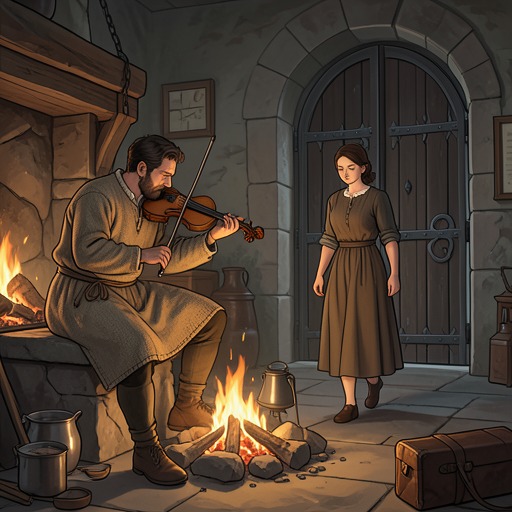
Oak comes to see Bathsheba intending to ask whether she would marry him. He brings a lamb, ostensibly as a present for her to rear, but tells her aunt that the animal is not the real reason for his visit. The aunt, Mrs. Hurst, says Bathsheba is away and mistakenly suggests that she has many young men interested in her. Oak, describing himself as an ordinary man, concludes that his chance depended on being the first to ask and starts home.
Bathsheba runs after him with a white handkerchief. She explains that she did not know he had come to court her and had hurried to correct her aunt’s report: she has no sweetheart and never has had one. Her motive is to prevent Oak from leaving with a false impression, not to accept him. As she puts it, she dislikes being thought of as men’s property, while allowing only that she might have a sweetheart someday. The contrast between his hopeful reading of her pursuit and her actual purpose sets the scene’s emotional course.
A Domestic Future Offered and Declined
Oak interprets Bathsheba’s explanation as encouragement and renews his suit. He describes the life he could provide: a piano for her, music from his flute, a gig for market, flowers and useful birds, and even a frame for cucumbers. He imagines their marriage being announced in the newspaper and their future as a couple sharing the home and family life. His proposal is at once practical and affectionate; he builds it out of recognizable comforts and the promise of constant companionship.
Bathsheba listens, briefly agreeing that she would like the things he names, but draws back when Oak reaches for her hand. A holly bush separates them as she moves away, and she tells him she never said she would marry him. She admits that being a bride would appeal to her in one respect: she might feel that she had won a social victory. But she does not want the permanent presence of a husband that the role entails. The distinction is decisive: she can imagine the display and status of a wedding without wanting the marriage itself.
Rejection and the Question of Independence
When Oak asks directly, Bathsheba says she does not love him. He answers that his love is enough for him and promises that he will love and long for her throughout his life. His sincerity unsettles her; she feels that refusing a man who cares so deeply seems wrong, but cannot turn that discomfort into consent. The scene thus separates affection from obligation: Oak’s constancy is real, but Bathsheba does not regard it as a reason to surrender her own judgment.
Bathsheba also gives a practical account of why the match does not suit her. She says she has little money and is staying with her aunt for bare sustenance, while Oak is a farmer just beginning his career. She argues that he would be more prudent to marry a woman with money. Oak agrees that this is what he had been thinking, and Bathsheba takes his admission as further proof that they cannot marry. He tries to clarify that he does not consider her beneath him, praising her speech and noting that her uncle at Weatherbury is a substantial farmer, but she tells him not to press her.
Her refusal is not simply a verdict on Oak’s means. She says that she wants someone who could tame her because she is too independent, and believes Oak could not do so. The statement registers the assumptions she makes about love and marriage, but it also confirms her reluctance to enter a relationship in which she expects her autonomy to be contested. Oak’s honest response to her argument briefly complicates his plea; Bathsheba is disconcerted when he acknowledges the practical point, then more resolute in rejecting him.
The Boundary Set and Its Later Resonance
Bathsheba’s refusal ends with an explicit boundary: she cannot marry Oak, does not love him, and asks him not to press her further. Oak accepts the decision and says firmly that he will ask no more. The restraint matters alongside his declaration of lasting love. He does not secure the future he imagines, and the scene closes not in agreement but in separation between his hope and her choice.
The episode establishes an early pattern in Bathsheba’s relation to marriage: she can see its social and material advantages while refusing it when it conflicts with desire or independence. Later, as mistress of Weatherbury Upper Farm, she openly claims responsibility for managing the farm herself and insists that her workers should not mistake her sex for ignorance of good and bad practice. Her independence has economic as well as romantic dimensions, and the scene’s language of marriage already links personal choice to money, status, and the organization of a household.
The novel later places that autonomy under pressure. During her marriage to Sergeant Troy, Bathsheba’s husband is described as ruling in the room of his wife; while he is absent, she fears losing the tenancy of Upper Farm and falling into poverty, and she does not know what legal effect the marriage will have on her position. These later circumstances do not change the meaning of Oak’s first proposal, but they sharpen its stakes: the domestic future he offers is not only a private romance but a form of life in which companionship, property, and a woman’s authority can become entangled. Bathsheba’s refusal therefore begins a lasting conflict between her desire to remain self-directed and the constraints and risks marriage brings in the story.